
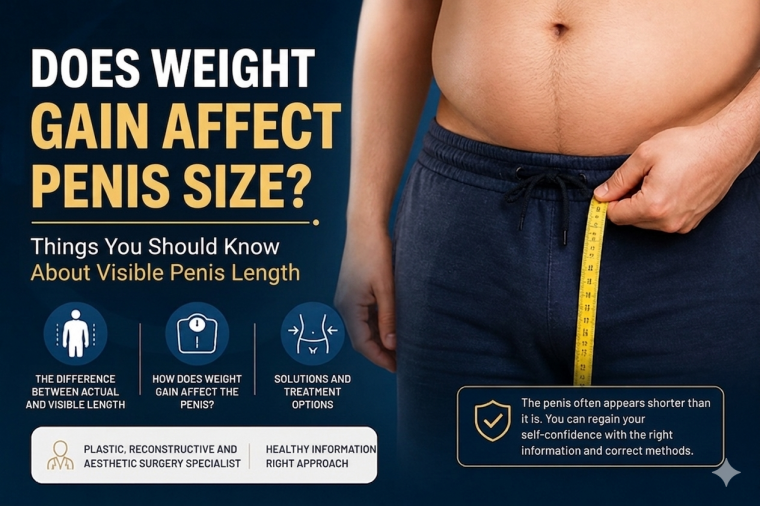
Does Weight Gain Affect Penis Size?
Does Weight Gain Affect Penis Size? What You Need to Know About Visible Penis Length
Weight gain can affect how long the penis appears, but it does not usually reduce the actual anatomical length of the penis. In many men, especially those who gain fat around the lower abdomen and pubic area, the base of the penis can become partially covered by surrounding fat tissue. As a result, the penis may look shorter even though its real size has not changed.
This is commonly related to a condition known as buried penis or hidden penis, where a normal-sized penis is partially or completely concealed by the skin, fat, or tissue around it. Dr Hakki Izmirli explains that excess weight around the abdomen and genital area can hide the penis, especially in people with severe obesity.
What Is Visible Penis Length?
Visible penis length refers to the part of the penis that can be seen outside the body. This is different from the penis’s true anatomical length. When fat builds up in the pubic region, the visible portion of the penis may become shorter because part of the shaft is hidden within the surrounding fat pad.
This can make some men feel as if their penis has shrunk. In reality, the penis itself may be the same size, but more of it is covered by fat or skin.
How Weight Gain Changes Penis Appearance
When body weight increases, fat may accumulate in different areas of the body. For many men, one of these areas is the lower abdomen and the pubic region. The fat pad above the penis is called the suprapubic fat pad.
As this fat pad becomes thicker, it can cover the base of the penis. The penis may then appear shorter when standing, sitting, or looking in the mirror. Medical literature describes adult-acquired buried penis as a condition where the penis remains attached normally, but the surrounding suprapubic fat pad can eventually surround and conceal it.
Does Weight Gain Actually Make the Penis Smaller?
No, weight gain does not usually make the penis physically smaller. The tissue of the penis does not shrink simply because a person gains weight. However, weight gain can reduce the visible length of the penis.
This means there is an important difference between:
Actual penis length: the full anatomical length of the penis.
Visible penis length: the part of the penis that can be seen outside the body.
With increased pubic fat, the visible length may decrease even though the actual length remains unchanged.
What Is a Buried Penis?
A buried penis is a condition in which the penis is hidden by surrounding tissue. It may be present from birth, but in adults it is often associated with obesity, excess abdominal fat, pubic fat, lymphedema, skin conditions, or scar tissue.
The Society for Sexual Medicine of North America states that buried penis may be caused by excess fat around the abdomen, fluid retention in the genital area, ligament issues, circumcision-related complications, or certain skin conditions.
In adult men, obesity-related buried penis is often linked to an overhanging suprapubic fat pad. A medical review also notes that buried penis in adults may involve a normal-sized penis that appears short or becomes hidden by abdominal or suprapubic skin or fat.
Common Signs of Reduced Visible Penis Length
Men who gain weight around the abdomen or pubic area may notice several changes, including:
- The penis appears shorter than before.
- The base of the penis looks hidden.
- More fat tissue is visible above the penis.
- The penis seems to retract into the pubic area.
- Hygiene becomes more difficult.
- Urine may be harder to direct.
- Sexual activity may feel more difficult or uncomfortable.
These symptoms can vary from mild to severe. Some men only notice a cosmetic change, while others may experience urinary, hygiene, or sexual problems.
Is This the Same as Micropenis?
No. A buried or hidden penis is not the same as micropenis.
Micropenis is a medical condition in which the penis is significantly smaller than expected for age and development. A buried penis, on the other hand, is often normal in size but hidden by surrounding tissue.
This difference is important because the causes and treatment options are different. A man with buried penis may have normal penile length, but excess fat, loose skin, swelling, or scar tissue can make the penis difficult to see.
Can Losing Weight Improve Visible Penis Length?
Weight loss may improve visible penis length in some men. When overall body fat decreases, the suprapubic fat pad may also become smaller. This can reveal more of the penile shaft and improve appearance.
However, weight loss does not always fully solve the problem. In some cases, loose skin, severe fat accumulation, scarring, or genital swelling may remain even after weight loss. When this happens, a urologist may recommend additional treatment options.
Treatment Options
Treatment depends on the cause and severity of the condition. Mild cases may improve with lifestyle changes, while more advanced cases may require medical or surgical treatment.
Possible treatment options include:
- Weight loss and body fat reduction
- Regular exercise
- Healthier eating habits
- Improved genital hygiene
- Treatment of skin irritation or infection
- Management of lymphedema if present
- Removal of excess suprapubic fat
- Abdominoplasty or panniculectomy in selected cases
- Reconstructive surgery for severe buried penis
Dr Hakki Izmirli lists treatment options such as suction lipectomy, abdominoplasty, and panniculectomy in certain cases where excess fat or skin contributes to the problem.
When Should You See a Doctor?
A man should consider seeing a urologist if the penis appears significantly shorter than before, if urination becomes difficult, or if there are repeated infections, skin irritation, unpleasant odor, pain, or sexual difficulties.
It is also worth seeking medical advice if weight gain has caused major concern about genital appearance or confidence. A urologist can examine whether the issue is related to pubic fat, buried penis, loose skin, scar tissue, lymphedema, or another medical condition.

Conclusion
Weight gain does not usually reduce the actual size of the penis. However, it can reduce visible penis length by increasing fat around the lower abdomen and pubic area. This can make the penis appear shorter, even when the anatomical length remains the same.
For many men, the issue is related to the suprapubic fat pad covering the base of the penis. Weight loss may help improve appearance in mild to moderate cases. In more advanced cases, medical or surgical treatment may be needed.
If reduced visible penis length is causing urinary problems, hygiene issues, sexual difficulties, or emotional distress, consulting a urologist is the best step.
Disclaimer: This article is for informational purposes only and does not replace professional medical advice. For diagnosis and treatment, consult a qualified healthcare provider.